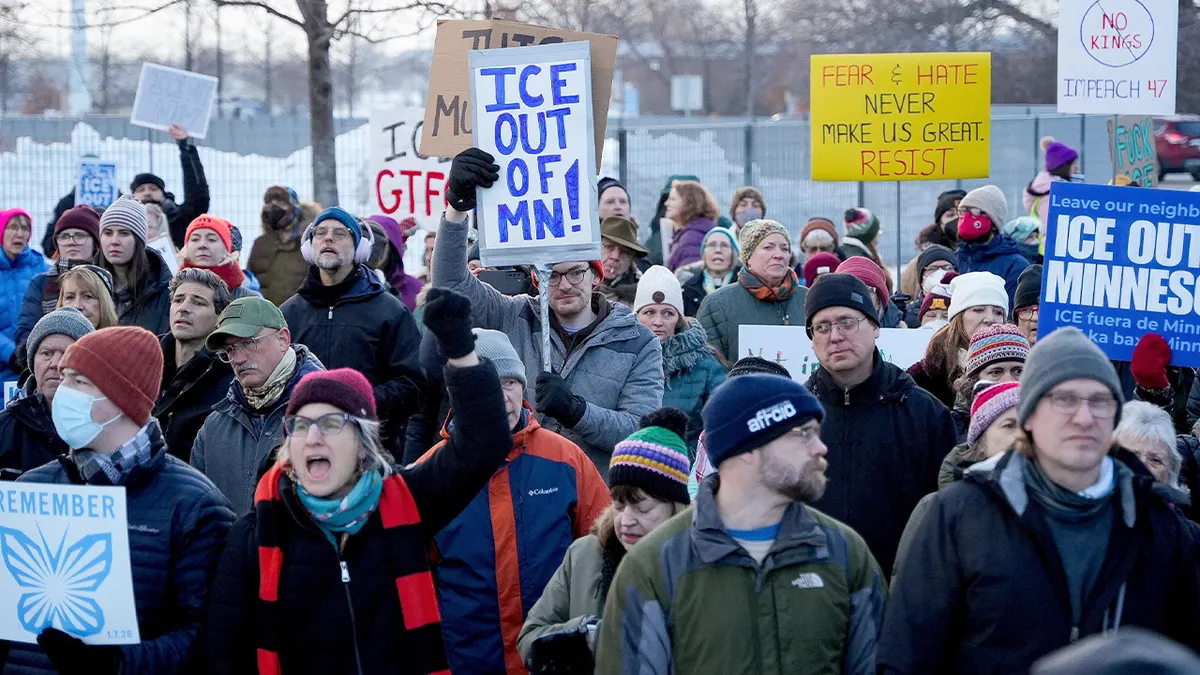
Homeland Security deploys additional agents to Minneapolis amid protests across the U.S. as tensions escalated following the fatal shooting of a woman by a federal immigration officer. Minneapolis, already on edge after Wednesday’s incident, saw an increased federal presence as the Department of Homeland Security (DHS) launched what it described as its largest enforcement action to date.
Minneapolis Braces for Expanded Federal Operations
On Sunday, Homeland Security Secretary Kristi Noem confirmed that “hundreds more” federal agents would be sent into Minneapolis. The announcement came as door-to-door enforcement actions began in residential neighborhoods, prompting immediate backlash from residents and activists. Protesters gathered outside homes, shouting at heavily armed agents, honking car horns, beating drums, and blowing whistles in an effort to interrupt the operations.
In one neighborhood dominated by single-family houses, confrontations intensified. Witnesses reported shoving between demonstrators and agents, and several people were sprayed with chemical irritants shortly before officers forced entry into a home. One man was later escorted away in handcuffs, fueling further outrage among the crowd.
Protests Spread After Fatal Shooting
The protests were sparked by the killing of Renee Good, a 37-year-old American citizen and mother of three, who was shot by an Immigration and Customs Enforcement (ICE) officer while driving away in her car. Video footage of the incident, captured from multiple angles, quickly circulated online and galvanized public anger.
On Sunday, demonstrators in Minneapolis marched toward the residential street where Good was killed. Despite freezing winds, turnout was strong, underscoring the depth of frustration not only over Good’s death but also over other recent shootings involving federal immigration enforcement. Earlier this week, border patrol agents in Portland, Oregon, shot and injured three people in a separate incident, adding to national concern.
Arrests, Injuries, and Official Responses
City officials confirmed that at least 30 people were arrested during Saturday’s protests. One police officer was injured after being struck by what authorities described as a “chunk of ice.” Minneapolis Mayor Jacob Frey emphasized that the overwhelming majority of demonstrators acted peacefully, even as emotions ran high.
Still, officials across the Twin Cities remained wary of further unrest. Minneapolis public schools announced plans to shift to remote learning for the next month, citing safety concerns for students and families amid ongoing demonstrations. Several schools had already closed in the days following Good’s death due to disruptions and security worries.
Community Organizing and Observer Networks
Local advocacy groups reported a surge in civic engagement. According to Luis Argueta, a spokesperson for Unidos MN, more than 20,000 people across Minnesota have participated in training sessions since the 2024 election to become “observers” of immigration enforcement activities.
“This is something people choose to do voluntarily,” Argueta said. “They want to look out for their neighbors and make sure actions are documented.”
Clashing Narratives From Officials
The shooting has exposed starkly different narratives from Minnesota’s Democratic leaders and the Trump administration. The incident occurred shortly after roughly 2,000 federal agents were deployed to the Minneapolis–St. Paul region, a move DHS labeled its largest operation ever.
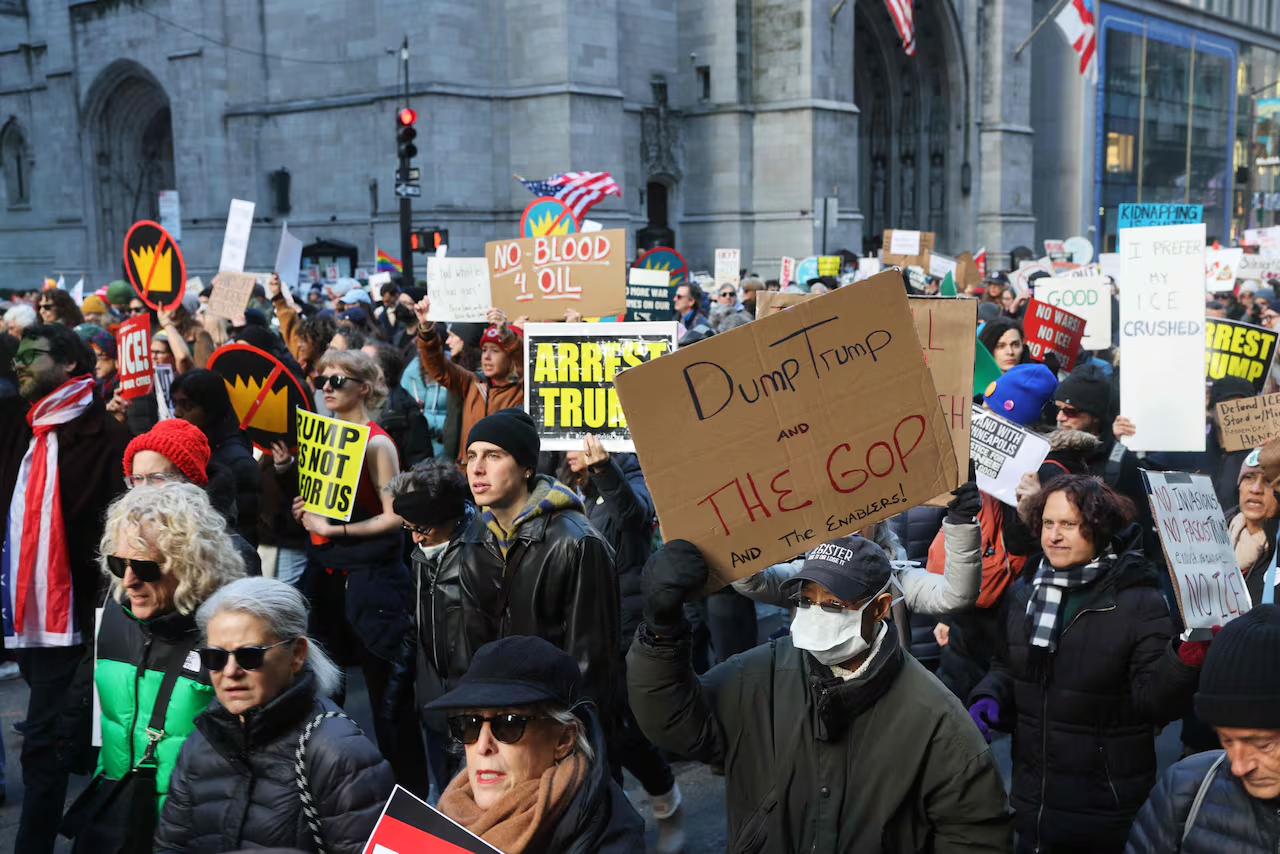
Trump administration officials accused Good, without presenting evidence, of being a “domestic terrorist.” Former President Donald Trump also claimed the ICE officer was “run over,” a statement contradicted by video footage. Mayor Frey responded forcefully, publicly calling on ICE officers to leave Minneapolis and criticizing federal authorities for blocking state investigators from assisting in the FBI’s probe.
“They were quick to jump to a narrative instead of the truth,” Frey said during a Sunday appearance on NBC’s Meet the Press.
Federal Reinforcements Continue
Despite the backlash, Secretary Noem reaffirmed the administration’s stance. Speaking to Fox News, she said additional agents would continue to arrive to ensure the safety of ICE and border patrol personnel operating in Minneapolis. DHS spokesperson Tricia McLaughlin added that more than 2,000 immigration arrests have been made in Minnesota since the operation began in early December.
Nationwide Demonstrations Gain Momentum
The unrest has not been limited to Minnesota. Over the weekend, thousands of protesters flooded streets across the country. In Los Angeles, crowds gathered near downtown federal buildings, marching along Alameda Street with upside-down American flags and signs condemning ICE. Police later issued dispersal orders, echoing similar confrontations on the same street last year.
California’s Bay Area also saw widespread demonstrations, with rallies reported in Oakland, Berkeley, San Jose, and San Francisco. In Salt Lake City, around 1,000 protesters circled Washington Square Park before assembling outside Utah’s third district court.
As investigations continue and federal operations expand, Homeland Security deploys additional agents to Minneapolis amid protests across the U.S., signaling a volatile moment in the national debate over immigration enforcement, accountability, and public trust.