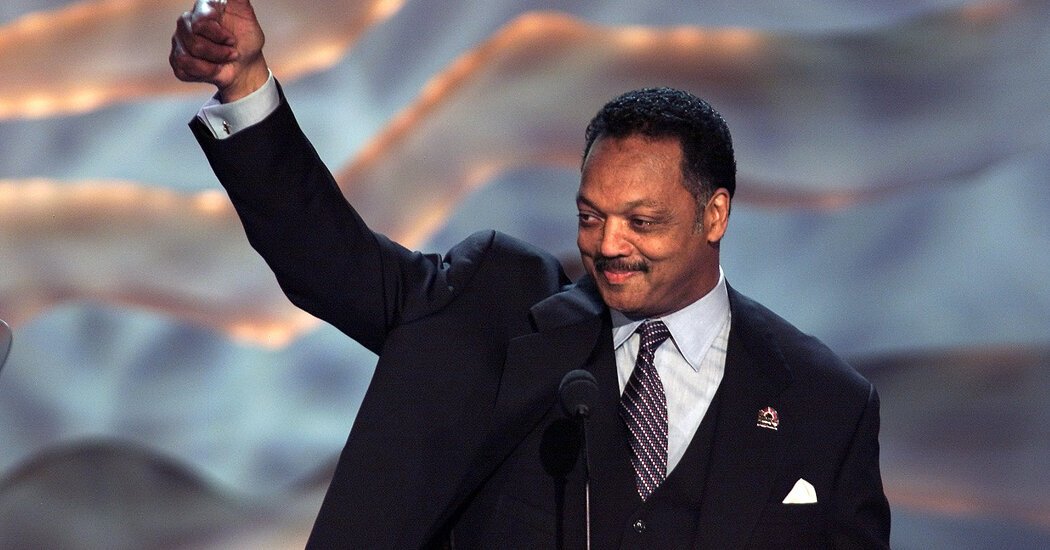
The nation is mourning the loss of Rev. Jesse Jackson, pioneering civil rights activist and former U.S. presidential hopeful, passes away at 84, marking the end of an era defined by decades of fearless advocacy for justice, equality, and human dignity.
The legendary Baptist minister and two-time Democratic presidential candidate died peacefully Tuesday morning, surrounded by his loved ones, according to a statement released by his family. He is survived by his wife, Jacqueline Jackson, six children, and several grandchildren.
In their heartfelt message, his family described him as a “servant leader” whose mission extended far beyond his own household.
“We shared him with the world, and in return, the world became part of our extended family,” the statement read. “His unwavering belief in justice, equality, and love uplifted millions.”
They urged supporters to honor his legacy by continuing the fight for fairness and opportunity — causes that shaped every chapter of his life.
A Life Shaped by the Struggle for Equality
Born Jesse Louis Jackson on October 8, 1941, in Greenville, South Carolina, Jackson came of age in the deeply segregated American South. He experienced firsthand the humiliations of Jim Crow — separate schools, buses, restrooms, and drinking fountains — realities that would fuel his lifelong determination to dismantle racial injustice.
As a student at North Carolina A&T State University in Greensboro, he joined the local chapter of the Congress of Racial Equality and became active in sit-ins and protests against segregated facilities. One of his early acts of defiance included participating in a protest at a whites-only library in Greenville — a bold move that resulted in his arrest but ultimately contributed to integration.
Reflecting years later, Jackson credited Greensboro as the “launching pad” of his activism, the place where his political consciousness fully awakened.
Protégé of Dr. Martin Luther King Jr.


Jackson’s national prominence began when he joined forces with Martin Luther King Jr. and the Southern Christian Leadership Conference (SCLC). After witnessing the brutality of “Bloody Sunday” in Selma in 1965, Jackson organized fellow seminary students to join the historic Selma-to-Montgomery marches.
Impressed by his passion and leadership skills, King offered Jackson a staff role within the SCLC. Jackson left seminary just three courses short of graduation to devote himself entirely to the civil rights movement, though he was ordained as a Baptist minister in 1968.
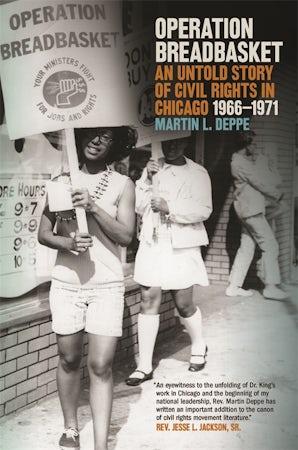
In Chicago, Jackson led Operation Breadbasket, an SCLC initiative aimed at pressuring corporations to hire Black employees and invest in Black communities. Under his leadership, the program secured thousands of new jobs and millions of dollars in income for underserved communities.
When King was assassinated in Memphis in 1968, Jackson was at the Lorraine Motel. The tragedy profoundly affected him and intensified his resolve to continue King’s mission.
Building His Own Movement
In 1971, Jackson founded Operation PUSH (People United to Serve Humanity), focusing on economic empowerment for Black Americans. Later, he created the National Rainbow Coalition, advocating for a broad alliance that included working-class Americans, women, and racial minorities.
These two efforts eventually merged into the Rainbow PUSH Coalition, where Jackson served as president for decades. The coalition championed voting rights, economic justice, education reform, and equal opportunity — principles that remained central to his activism.
A Historic Run for the Presidency


Jackson made history in 1984 when he launched a campaign for the Democratic presidential nomination, becoming only the second Black American to mount a nationwide bid for the presidency. Though critics underestimated him, he defied expectations, winning several primaries.
In 1988, he ran again and finished second in the Democratic primary race, delivering one of the most memorable speeches at the Democratic National Convention that year. His campaigns emphasized coalition-building across racial and economic lines, pushing for expanded civil rights, workers’ protections, and women’s equality.
While he never secured the nomination, his runs reshaped American politics and paved the way for future candidates of color.
Diplomacy and Global Advocacy
Jackson’s influence extended beyond domestic politics. In the 1980s and 1990s, he negotiated the release of hostages and prisoners in countries such as Syria, Cuba, Iraq, and Kuwait — often operating independently of official U.S. diplomatic channels.
In 1997, President Bill Clinton appointed him U.S. special envoy to Africa. Jackson described the appointment as a profound journey — from a segregated Southern childhood to representing America abroad.
He also served as a “shadow senator” for Washington, D.C., lobbying for statehood and equal representation in Congress.
Controversies and Personal Struggles
Jackson’s long career was not without controversy. During the 1984 presidential primary, he made offensive remarks about Jewish Americans, comments he initially denied and later publicly apologized for. The incident drew widespread criticism and even became the subject of satire on Saturday Night Live — a show he would later host himself.
In 2001, Jackson acknowledged an extramarital affair that resulted in the birth of a daughter, a revelation that deeply affected his public image.
In 2017, he announced he had been diagnosed with Parkinson’s disease. In 2021, both he and his wife were hospitalized with COVID-19 but later recovered.
A Voice That Never Faded
Even as his public appearances became less frequent in recent years, Jackson never stopped advocating for fairness in voting rights, economic opportunity, and equal protection under the law.
In a 2018 podcast interview, he argued that Americans deserved “an even playing field,” warning that democracy could not thrive without transparent rules and equal access.
His family described him as a “tireless change agent” who helped mobilize millions to vote and inspired generations to believe that change was possible.
A Legacy That Endures
The passing of Rev. Jesse Jackson, pioneering civil rights activist and former U.S. presidential hopeful, passes away at 84, closes a remarkable chapter in American history — but his impact remains embedded in the nation’s political and social landscape.
From marching across the Edmund Pettus Bridge to standing on the debate stage in presidential primaries, Jackson consistently challenged America to live up to its highest ideals.
His life was defined by conviction — a belief that democracy must include everyone, that economic justice matters as much as civil rights, and that dignity belongs to all.
As tributes pour in, one truth stands clear: Jesse Jackson did not merely witness history — he helped shape it.