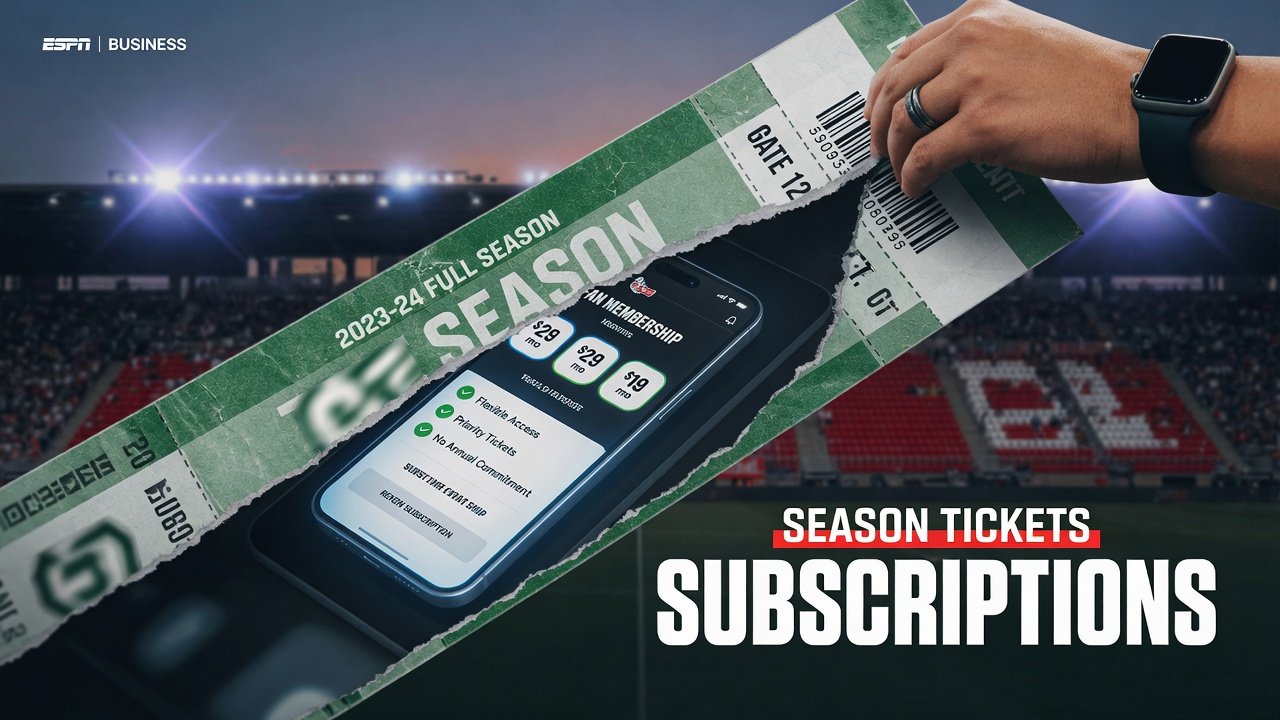
The End of Traditional Season Tickets: Sports Teams Embrace Subscription-Based Fan Memberships
The traditional season ticket is undergoing a major transformation as professional sports franchises across North America look for new ways to generate recurring revenue and maintain stronger relationships with fans.
Instead of relying exclusively on large upfront purchases for an entire season, teams are increasingly exploring membership-based and subscription-style ticketing models that can provide fans with more flexibility while giving organizations access to valuable customer data.
The shift is part of a broader change in sports ticketing. A recent PwC analysis describes the movement as a transition from traditional season tickets toward memberships and passes, with pricing flexibility, resale strategies and loyalty programs becoming increasingly important to teams.
The San Francisco 49ers are among the franchises operating in this changing environment, maintaining a season-ticket membership structure with benefits that extend beyond simply attending games. The team’s official membership program includes perks such as concession discounts and other stadium benefits.
Why Sports Teams Are Rethinking Season Tickets
For decades, season tickets provided sports franchises with one of their most predictable revenue streams.
A fan paid for a package covering most or all home games, while the team received substantial revenue before the season even began.
But consumer behavior has changed.
Many fans no longer want to commit to dozens of games. They may have changing work schedules, travel frequently, prefer watching some games at home or simply want the freedom to select individual matchups.
That creates a challenge for teams.
A traditional season-ticket model can lock fans into a relatively rigid product. Subscription-style memberships can instead give teams the ability to offer different levels of access and pricing.
From Season Tickets to “Memberships”
The biggest change is partly about terminology and partly about business strategy.
Rather than treating the customer simply as a ticket buyer, teams increasingly view the person as a long-term member of a digital ecosystem.
A membership can potentially combine:
- Game tickets or ticket credits
- Priority access
- Exclusive events
- Merchandise discounts
- Food and beverage benefits
- Digital content
- Loyalty rewards
- Seat upgrades
- Resale opportunities
- Personalized offers
The result is a relationship that can continue even when a fan does not attend every game.
The 49ers, for example, already describe their traditional season-ticket customers as Season Ticket Members, with benefits extending beyond game admission.
The Real Prize: Fan Data
One of the biggest reasons behind the shift is not necessarily the ticket itself.
It is the data generated by the fan relationship.
A team can potentially learn how often a customer attends games, which opponents attract them, what food they purchase, which merchandise they buy, how frequently they use a mobile app and how they respond to promotional offers.
That information can then be used to create more personalized marketing.
Sports technology companies are increasingly offering systems designed to connect ticketing, merchandise, digital engagement and other customer information so teams can build a more complete picture of individual fans.
This turns ticketing into something closer to a customer relationship platform.
Why Recurring Revenue Matters
Traditional season tickets already provide recurring annual revenue, but subscriptions could potentially make the relationship even more flexible.
Instead of relying on one major transaction once a year, teams can experiment with:
Monthly memberships → annual memberships → premium upgrades → digital benefits → merchandise → food and beverage → hospitality → additional ticket purchases
This creates multiple opportunities to monetize the same customer.
For sports franchises, that can be attractive because the value of a fan is no longer limited to the number of games included in a ticket package.
The New Model Could Also Help Younger Fans
Younger consumers may be less interested in committing thousands of dollars to a traditional season-ticket package.
A lower-cost membership could allow a fan to enter the team’s ecosystem without making a major upfront commitment.
For example, a hypothetical membership could offer priority access and discounted tickets for a monthly fee, while a premium tier could provide guaranteed seats or hospitality benefits.
This kind of structure resembles subscription businesses in entertainment and technology, where customers choose a level of access based on their needs.
The objective is to reduce the barrier to becoming a paying fan.
Resale Is Changing the Equation
Ticket resale has also complicated the traditional season-ticket business.
A season-ticket holder may not attend every game, particularly when the team has a weaker opponent or an inconvenient schedule.
Modern membership systems can potentially incorporate resale tools, ticket exchanges and flexible seat management.
That gives fans more control while allowing teams to maintain a relationship with the customer even when the original ticket changes hands.
PwC identifies resale strategies as one of the important elements of the evolving sports-ticketing landscape.
Teams Still Need Traditional Season-Ticket Buyers
The shift does not mean traditional season tickets are disappearing overnight.
For many franchises, season-ticket members remain among their most valuable and loyal customers.
Premium seating, corporate hospitality, luxury suites and long-term seat relationships can generate significant revenue.
Instead, the emerging model is more accurately viewed as an expansion of the traditional system.
Teams can maintain premium season-ticket products while introducing flexible memberships for fans who want something different.
That creates a broader customer ladder rather than a single ticketing option.
The San Francisco 49ers Show How the Concept Is Evolving
The 49ers offer a useful example of how the language around ticket customers has already changed.
Their official website uses the term Season Ticket Member and highlights benefits beyond access to games, including food and concession-related perks.
The team is also expanding its brand internationally. Its 2026 season opened with a historic game against the Los Angeles Rams in Melbourne, demonstrating how modern sports franchises increasingly operate as global entertainment brands rather than organizations focused only on their home stadiums.
That global approach makes direct fan relationships and digital engagement increasingly valuable.
Subscription Sports Could Create More Personalized Pricing
Another major possibility is personalized pricing.
Instead of every customer receiving essentially the same season-ticket package, teams can potentially create different products based on demand and behavior.
A casual fan could receive a low-cost membership.
A frequent attendee could receive a larger ticket allocation.
A premium customer could receive hospitality and exclusive access.
A corporate customer could receive flexible tickets designed for business use.
Technology makes it easier for teams to manage these different categories.
What Fans Could Gain
The transition is not necessarily one-sided.
Flexible memberships could benefit fans who cannot attend every game.
Instead of paying for 10, 20 or 40 games they may not use, fans could purchase smaller packages or memberships designed around their actual attendance patterns.
Additional benefits such as priority ticket access, discounts and exclusive experiences could also make memberships attractive.
The challenge will be ensuring that increased flexibility does not simply become another way to raise prices.
What Could Be Lost?
There is also a cultural side to the change.
Traditional season tickets have historically created a strong sense of belonging. Fans often sit in the same seats, develop relationships with neighboring supporters and attend games as part of a long-standing routine.
A heavily digital, subscription-driven system could make that relationship feel more transactional.
If memberships become too complicated or expensive, some longtime fans could feel that teams are prioritizing data and revenue optimization over community.
The success of the model will therefore depend on balancing business efficiency with the emotional connection that makes sports different from ordinary entertainment.
A New Sports Business Model Is Emerging
The evolution of ticketing reflects a much larger transformation in professional sports.
Teams are no longer simply selling seats.
They are selling access, identity, experiences, content, loyalty and community.
The stadium remains important, but the relationship with the fan increasingly extends into mobile apps, social platforms, digital content, merchandise and loyalty programs.
That means the future of sports ticketing may not be about choosing between season tickets and individual tickets.
Instead, fans could be offered a spectrum of memberships, subscriptions and premium experiences tailored to how they want to interact with a team.
The End of Traditional Season Tickets May Be the Beginning of Something Bigger
The traditional season ticket is unlikely to disappear completely. Premium customers, longtime supporters and corporate buyers will continue to value guaranteed seats and full-season access.
But the business model around those tickets is changing.
As teams become more sophisticated at collecting and using fan data, the definition of a “season-ticket holder” is evolving into something closer to a long-term customer relationship.
The future could belong to teams that can turn occasional spectators into year-round members.
For sports franchises, that means the most valuable fan may no longer be the person who simply buys the most tickets.
It may be the fan who remains connected to the team 365 days a year.
Frequently Asked Questions
Are traditional season tickets disappearing?
Not completely. Traditional season-ticket packages remain important to professional sports teams, particularly for premium and highly loyal customers. The change is that franchises are increasingly adding flexible memberships, passes and subscription-style products.
What is a sports membership?
A sports membership is a broader fan package that can combine tickets with benefits such as priority access, discounts, digital content, merchandise offers, loyalty rewards and exclusive experiences.
Why are sports teams interested in subscription models?
Subscription models can provide recurring revenue, increase fan engagement and give teams more opportunities to understand customer behavior and personalize offers.
Why is fan data important to sports teams?
Fan data can help teams understand attendance patterns, purchasing behavior, ticket preferences and engagement. That information can be used to improve marketing, ticket pricing and personalized fan experiences.
Are the San Francisco 49ers using a membership model?
The 49ers already use the term Season Ticket Members and provide members with benefits beyond game admission, including concession-related perks.
Will subscription memberships make sports tickets cheaper?
Not necessarily. Subscription models can offer lower-cost entry points, but premium memberships and additional benefits may also carry higher prices. The impact will depend on how individual teams structure their programs.
What does the future of sports ticketing look like?
The industry is moving toward a combination of traditional season tickets, flexible ticket packages, memberships, passes, resale tools and digital loyalty programs. PwC describes this broader movement as a shift from conventional season tickets toward memberships and passes.