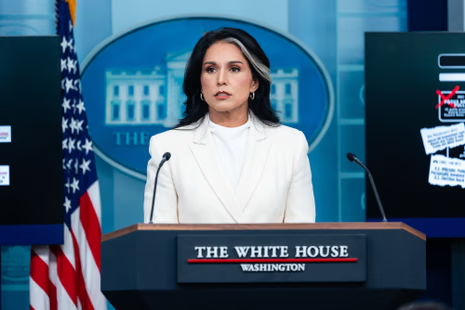
More facts come to light regarding the whistleblower complaint against Tulsi Gabbard as new details emerge about the origins of the allegations and how they were handled inside the intelligence community.
According to the whistleblower’s attorney, the complaint centers on an intercepted conversation between two foreign nationals who were allegedly discussing an individual with close ties to President Donald Trump. The lawyer, Andrew Bakaj, said the two individuals involved in the conversation were likely connected to foreign intelligence services. He also noted that access to the intercepted material was limited, with President Trump’s chief of staff, Susie Wiles, among those who were able to review it.
The whistleblower has claimed that the intelligence related to this intercept was deliberately restricted from wider distribution within the administration for political reasons. The intelligence community’s inspector general acknowledged this allegation in its review. Tulsi Gabbard, who serves as Director of National Intelligence, has firmly rejected the claims, calling them unfounded and politically driven.
Media outlets were the first to reveal key aspects of the case. The New York Times reported on the intercepted communication, while The Wall Street Journal initially disclosed the existence of the whistleblower complaint itself.
The complaint was formally submitted to the intelligence community’s inspector general in May. A month later, the whistleblower requested that it be forwarded to Congress. However, lawmakers did not receive the complaint until last week, a delay that has fueled controversy. NBC News previously reported on the timeline and the growing frustration surrounding it.
Bakaj has accused Gabbard of intentionally slowing the process and attempting to keep the complaint from reaching Congress. Gabbard has strongly denied those accusations, stating that she followed the law and proper procedures, and reiterating that the complaint lacks merit.
Democrats on Capitol Hill have criticized how the situation was handled, particularly the delay in briefing Congress. At the same time, many have stopped short of endorsing the substance of the whistleblower’s claims. Senator Mark Warner of Virginia, the vice chair of the Senate Intelligence Committee, said the version shared with lawmakers was heavily redacted, limiting their ability to fully assess it.
The inspector general’s office has also shifted its assessment over time. An initial review found it could not determine whether the allegation of politically motivated restriction was credible. A later assessment, based on additional evidence, concluded that the claim did not appear to be credible.
Under U.S. law, intelligence community whistleblowers are entitled to anonymity and protection from retaliation. Bakaj has said his client is willing to meet directly with members of Congress to explain concerns about how the complaint was processed.
However, the Office of the Director of National Intelligence (ODNI) has warned Bakaj that he does not have the legal authority to independently brief lawmakers on his client’s case. Despite this, Bakaj informed Gabbard’s office that he and his client were preparing to speak with Congress, citing the need for clearer security guidance on how to discuss classified elements of the complaint.
In a letter to Bakaj, ODNI General Counsel Jack Dever pushed back on the lawyer’s claims, stating that the complaint was not hidden from Congress and that appropriate guidance had already been provided. Dever also wrote that Bakaj’s interpretation of the law allowing him to go directly to Congress was incorrect. The letter was later published online by Whistleblower Aid, a nonprofit organization supporting the whistleblower.
Bakaj responded by reaching out to leaders of the House and Senate intelligence committees, saying his team is continuing to engage with the DNI’s office and would welcome congressional involvement in seeking clearer answers.
The dispute highlights the complex balance built into U.S. whistleblower laws, including the Intelligence Community Whistleblower Protection Act of 1998. These laws are intended to give government employees a safe path to report wrongdoing, while also safeguarding classified information and national security. As the debate continues, lawmakers are left to navigate both the procedural questions and the broader implications for oversight and transparency within the intelligence system.