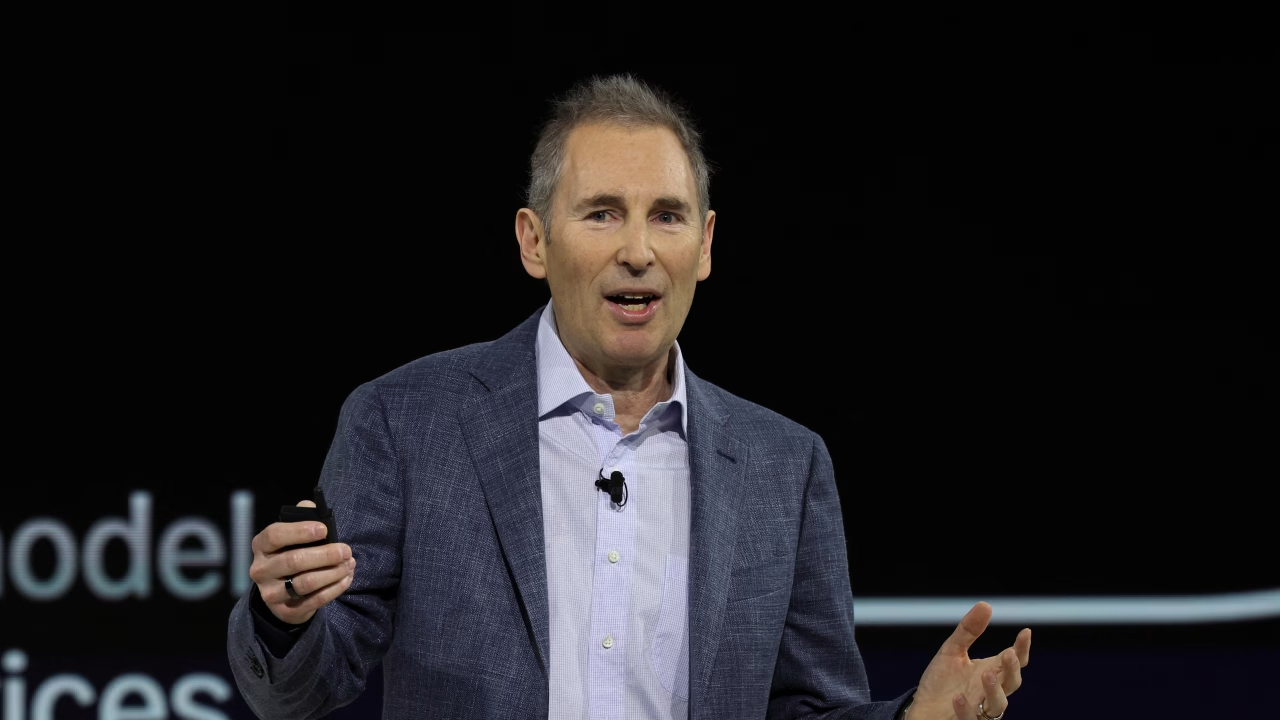
Eric Vaughan, CEO of enterprise software giant IgniteTech, made a decision that shook the company to its core—and the tech world took notice. In early 2023, convinced that generative AI represented an “existential” shift, Vaughan found himself facing a workforce hesitant to embrace this transformation. His solution was dramatic: over the course of a year, he replaced nearly 80% of his staff, according to headcount data reviewed by Fortune. Today, he stands firm on that choice, with This CEO cut almost 80% of his workforce for resisting rapid AI adoption—and two years later, he stands by his decision.
Recognizing the AI Inflection Point
For Vaughan, the signs were unmistakable. “In early 2023, we saw the light,” he told Fortune in August 2025, emphasizing that every company faced a critical decision about AI adoption. While others viewed AI as a promising tool, Vaughan saw urgency. He believed failing to act swiftly could threaten even the strongest businesses.
In response, Vaughan convened his global team and issued a stark message: AI would be the center of everything at IgniteTech. Employees were offered training, tools, and dedicated projects to master AI. “We’re giving a gift: time, resources, and guidance to build new skills,” he explained.
“AI Monday” and the Limits of Persuasion
To embed the culture, Vaughan introduced “AI Monday,” when all employees—across sales, marketing, finance, and engineering—focused exclusively on AI projects. The investment was significant: 20% of payroll went into these learning initiatives. Yet despite the resources, resistance remained, and in some cases, active sabotage emerged.
“In those early days, we got flat-out resistance,” Vaughan recalled. “And so we said goodbye to those people.”
Interestingly, the pushback came mainly from technical staff, not the broader workforce. Marketing and sales teams embraced AI tools, while some technical employees focused on limitations rather than opportunities.
The Human Side of AI Resistance
Vaughan’s experience mirrors broader research. The 2025 Enterprise AI Adoption Report from Writer found that one in three employees admitted to “actively sabotaging” AI rollouts, with millennials and Gen Z leading at 41%. Frustration, lack of trust, and fear of obsolescence often drove this behavior, whether through avoiding training, producing low-quality outputs, or resisting use of new tools.
Kevin Chung, Writer’s chief strategy officer, explained, “This sabotage isn’t about fear of technology—it’s about frustration when tools don’t meet expectations and employees feel compelled to ‘figure it out’ on their own.”
Vaughan recognized that belief could not be forced. “You can’t compel people to change if they don’t truly believe in it,” he said.
Building a New Workforce
Ultimately, IgniteTech launched a global recruitment effort for “AI innovation specialists” across all departments. Key hires, including Thibault Bridel-Bertomeu as chief AI officer, enabled a company-wide reorganization where every division reported into the AI organization. This centralization prevented siloed work, a common pitfall in AI adoption noted in Writer’s report.
By the end of 2024, IgniteTech had launched two patent-pending AI solutions, including the AI-driven email automation platform Eloquens AI. Financially, the company thrived, achieving near 75% EBITDA while completing a major acquisition, Khoros. Vaughan credited the transformation to empowering employees to “multiply themselves” through AI.
Lessons in Radical Change
Vaughan’s approach may be extreme, but it highlights a key insight: investment in AI without belief and cultural buy-in is often wasted. “Changing minds was harder than adding skills,” he said, reflecting on the arduous process of rebuilding his team from scratch.
Industry experts see multiple paths for AI adoption. Joshua Wöhle, CEO of AI upskilling firm Mindstone, contrasts mass replacement with reskilling. Companies like Ikea focus on augmentation—using AI to enhance human work rather than replace it—while Klarna reduced workload through AI but redeployed staff effectively. Still, Wöhle notes, “The pace of change is so fast that sometimes dismissing resistant workers is actually kinder.”
Looking Ahead
From Vaughan’s perspective, AI is far from a one-time change. “This is not a tech change. It is a cultural change, and it is a business change,” he said. Monthly all-hands meetings now revolve around demos rather than metrics, reflecting a new, AI-driven culture.
And would he do it again? Without hesitation. Vaughan prefers enduring the pain of restructuring to letting the company drift into irrelevance. This CEO cut almost 80% of his workforce for resisting rapid AI adoption—and two years later, he stands by his decision.