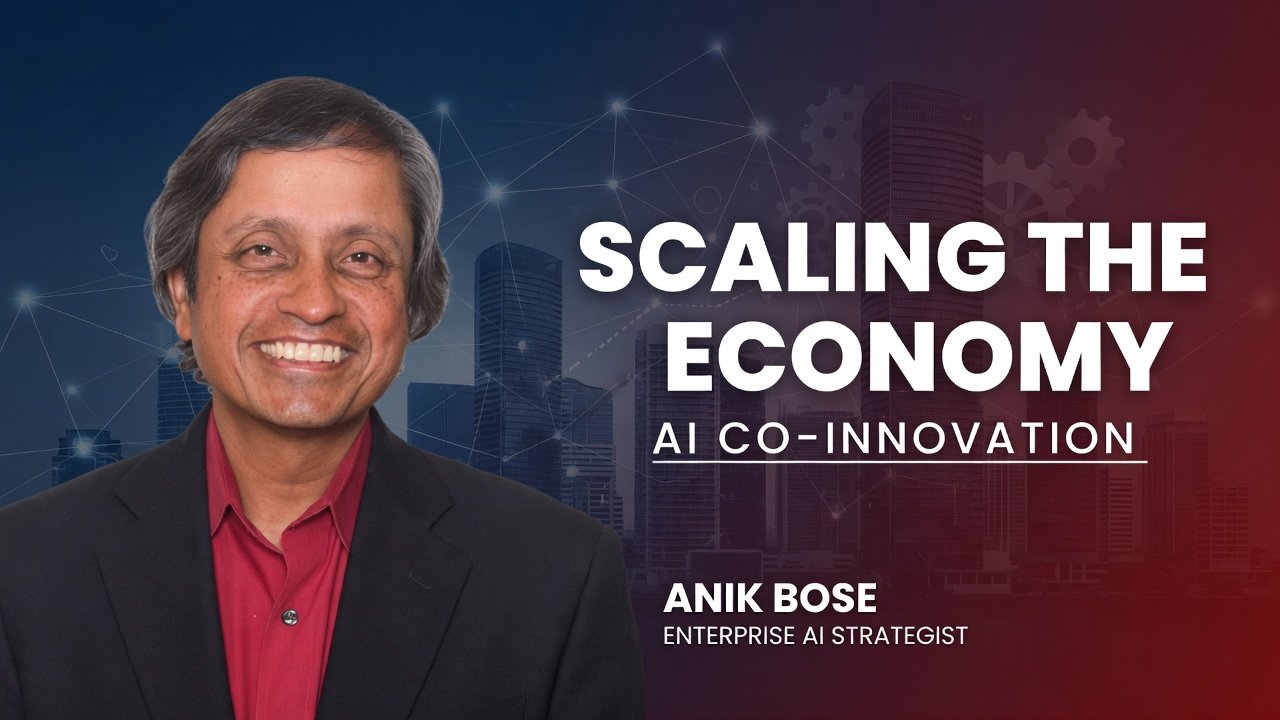
Scaling the Physical Economy: Anik Bose Urges AI Startups to Co-Innovate With Enterprises
Scaling the Physical Economy is becoming a central challenge for AI startups as artificial intelligence moves beyond software applications and into factories, warehouses, logistics networks, healthcare facilities and other real-world environments.
At today’s Menlo Park AI Summit, Anik Bose, founder of EAIGG, urged startup founders to rethink how they approach the next phase of AI development. His message centered on collaboration: startups looking to scale physical AI should avoid operating in isolation and instead work directly with large enterprises to develop and deploy solutions.
The comments come as businesses increasingly explore AI-powered robotics, automation, computer vision and intelligent industrial systems that interact with the physical world.
Anik Bose Calls for a Different Startup Approach
Bose’s message to founders focused on the limitations of building AI solutions in isolation.
Software startups can often develop products within relatively controlled digital environments. Physical AI presents a different set of challenges because technologies have to function within existing facilities, machinery, supply chains, safety procedures and operational workflows.
For startups, working directly with major enterprises can provide access to these real-world environments and the operational knowledge needed to build solutions that can eventually scale.
Rather than developing a product independently and approaching enterprises only after it is complete, Bose emphasized a model in which startups and large companies co-innovate from the beginning.
What Does Scaling the Physical Economy Mean?
The concept of Scaling the Physical Economy refers to expanding AI technologies into industries and activities that involve physical infrastructure, machines, products and human workers.
This includes areas such as:
- Manufacturing and industrial automation
- Warehouse and logistics operations
- Robotics
- Construction
- Transportation
- Healthcare
- Energy infrastructure
- Agriculture
- Retail operations
- Supply-chain management
Physical AI systems can combine machine learning with sensors, cameras, robotics and other technologies to understand and respond to real-world environments.
However, deploying such systems at scale is significantly different from launching a conventional software application.
A digital product can potentially reach millions of users through the internet. A robotic or industrial AI system may need to be integrated with specific machinery, tested under different operating conditions and validated against safety and reliability requirements.
Why Enterprise Collaboration Matters
Large enterprises operate some of the world’s most complex physical systems. They also have years of operational data and experience that can be difficult for a startup to replicate independently.
For an AI startup, collaboration with an enterprise can therefore provide several advantages.
Access to Real-World Problems
Startups can gain a better understanding of the problems companies actually face on factory floors, in warehouses and across supply chains.
This can help founders identify opportunities where AI can deliver measurable operational improvements rather than simply demonstrating technical capabilities.
Real Deployment Environments
Physical AI needs to operate outside laboratory conditions.
Factories may have different layouts, lighting conditions, machinery, safety requirements and workflows. Enterprise collaboration allows startups to test their systems against those realities.
Faster Product Refinement
Working closely with enterprise customers can create a feedback loop between technology development and operational requirements.
Instead of building a product based solely on assumptions, startups can refine their systems based on how they perform in real environments.
Path to Larger Deployments
A successful pilot with a major enterprise can potentially create opportunities for deployment across multiple facilities or business units.
That scalability is particularly important for startups working in robotics and industrial AI, where hardware, integration and deployment costs can be significant.
Physical AI Is Moving Beyond Demonstrations
The growing interest in physical AI reflects a broader shift in the artificial intelligence industry.
Generative AI initially transformed how businesses interacted with software and information. The next stage increasingly involves AI interacting with the physical world.
Robots equipped with advanced AI models can potentially perceive their surroundings, interpret instructions and perform tasks. Industrial systems can use computer vision to inspect products, monitor equipment and identify anomalies. Autonomous systems can assist with transportation and logistics.
But moving from a demonstration to reliable commercial deployment remains a major challenge.
This is where enterprise participation becomes important.
Startups and Enterprises Bring Different Strengths
The relationship between startups and large companies can be mutually beneficial.
Startups typically bring speed, specialized technical expertise and a willingness to experiment with new approaches. Enterprises bring infrastructure, operational expertise, customers, capital and access to large-scale deployment environments.
Co-innovation attempts to combine these strengths.
Instead of viewing an enterprise simply as a potential customer, startups can treat it as a development partner. That can result in products designed around real operational requirements from the beginning.
For large companies, working with startups can provide access to emerging technologies without requiring them to build every capability internally.
The Challenge of Moving From Pilot to Scale
One of the biggest obstacles for physical AI companies is the transition from a successful pilot to widespread deployment.
A system may perform well at one facility but encounter different conditions at another location. Hardware availability, network infrastructure, employee workflows and regulatory requirements can also vary.
Startups therefore need to consider scalability early in the development process.
Enterprise partnerships can help expose these challenges earlier, allowing companies to develop technology that is more adaptable across different environments.
This is particularly relevant to robotics, where deployment often requires integration with existing equipment and operational systems.
Menlo Park AI Summit Highlights Physical AI Opportunity
The Menlo Park AI Summit brings together technology companies, investors and entrepreneurs around the development of AI technologies and their real-world applications.
The discussion around Scaling the Physical Economy reflects the growing attention being given to AI’s role outside traditional software markets.
As AI models become more capable, companies are exploring how those capabilities can be connected to machines, sensors, robots and industrial infrastructure.
That creates a much broader opportunity for startups, but it also introduces a new set of technical and commercial challenges.
A New Model for AI Startup Growth
Bose’s message points toward a potential change in how founders approach physical AI businesses.
For software startups, building independently before pursuing customers can sometimes work. For physical AI companies, the path may require much closer interaction with enterprises from the outset.
Founders may need to understand not only AI models and robotics but also manufacturing processes, workforce requirements, maintenance, safety and supply-chain operations.
That makes cross-industry collaboration an important part of building physical AI businesses.
What Comes Next for the Physical Economy?
The expansion of AI into the physical economy is still developing, and adoption will likely vary significantly across industries.
Companies will need to determine where AI can produce measurable improvements while addressing reliability, safety, integration and economic considerations.
For startups, the opportunity is substantial, but success will depend on more than developing advanced technology. Building relationships with enterprises and understanding the environments in which these systems operate could become an increasingly important part of scaling.
The message from the Menlo Park summit is therefore centered on a straightforward shift: physical AI startups may need to build with enterprises, rather than simply build for them.
Frequently Asked Questions
1. What is Scaling the Physical Economy?
Scaling the Physical Economy refers to expanding AI and automation technologies into real-world industries such as manufacturing, logistics, healthcare, transportation, energy and robotics.
2. Who spoke about Scaling the Physical Economy at the Menlo Park AI Summit?
Anik Bose, founder of EAIGG, discussed the importance of collaboration between AI startups and large enterprises.
3. What did Anik Bose tell AI founders?
Bose stressed that startups should avoid developing physical AI solutions in isolation and should instead work directly with major enterprises through co-innovation.
4. What is physical AI?
Physical AI refers to artificial intelligence systems that interact with the physical world through technologies such as robotics, sensors, computer vision and autonomous machines.
5. Why do physical AI startups need enterprise partnerships?
Enterprise partnerships can provide startups with access to real-world operating environments, industry expertise, infrastructure and opportunities to test and deploy their technologies.
6. How is physical AI different from software AI?
Physical AI has to interact with real-world environments and often involves hardware, machinery, sensors, safety requirements and physical workflows, making deployment more complex than many purely digital applications.
7. Which industries could benefit from physical AI?
Manufacturing, logistics, transportation, healthcare, agriculture, construction, energy and retail are among the industries where physical AI and automation could be applied.
8. What does co-innovation mean for AI startups?
Co-innovation involves startups and enterprises working together during the development process instead of treating the enterprise solely as a customer after a product has already been built.
9. What is a major challenge for physical AI companies?
Moving from a successful pilot to deployment across multiple locations can be challenging because facilities, equipment, workflows and operating conditions can differ.
10. Why is the physical economy becoming important for AI?
As AI capabilities expand, businesses are exploring applications beyond software and digital services, including robotics, industrial automation, logistics and other systems that directly interact with the physical world.